Leveraged Executive Bonus
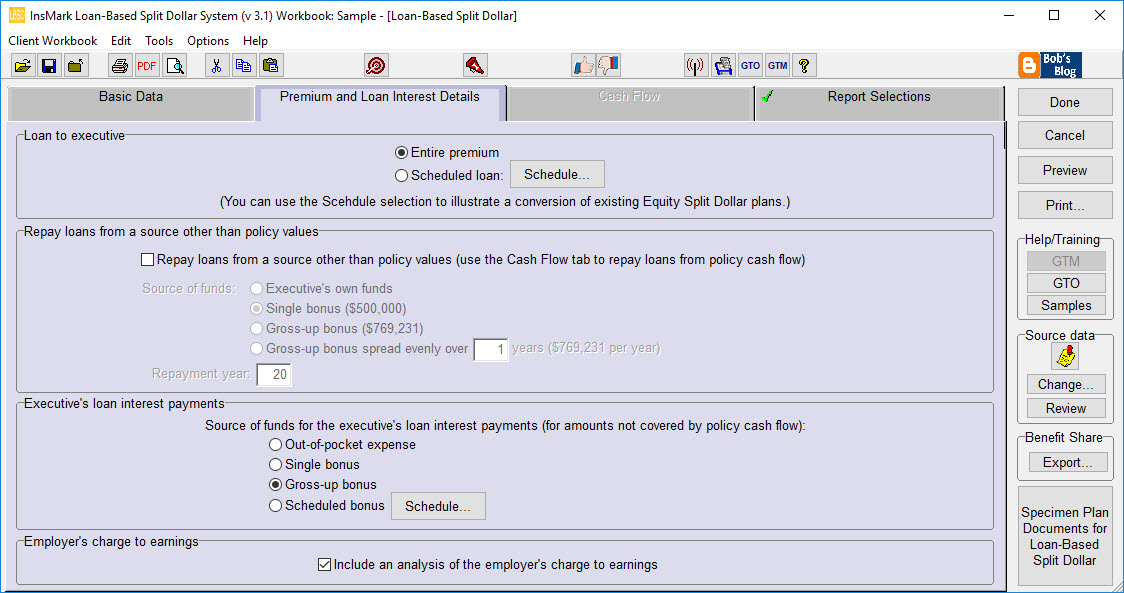
Both illustrations reflect a $2,500,000 policy with five $100,000 premiums. The employer provides the insured executive with a bonus of $100,000 for each of the five premiums. The employer also loans the executive an amount equal to the income tax due on each bonus. (Total loans: $40,000 x 5 = $200,000.)
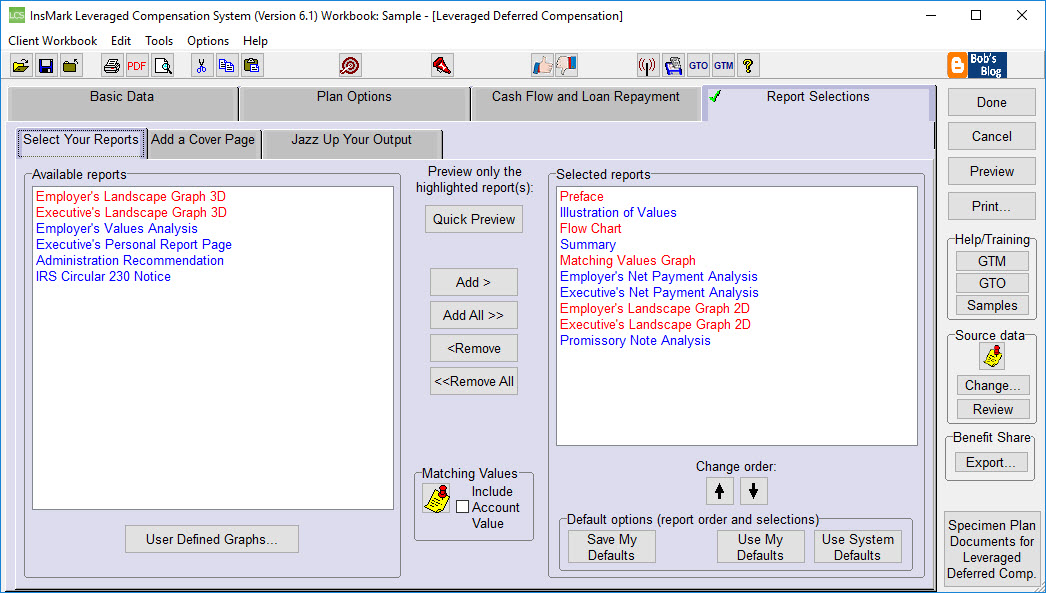
A further bonus is illustrated to provide the executive with the funds for the loan interest due -- resulting in an out-of-pocket cost to the executive of just the income tax on this bonus. (Be sure you examine the Matching Values report for this Sample Illustration as it shows that the executive would have to earn 38.24% in his out-of-pocket cost to match the results of the benefit.)
Note: A gross-up bonus for the loan interest could reduce the executive’s out-of-pocket cost to $0.
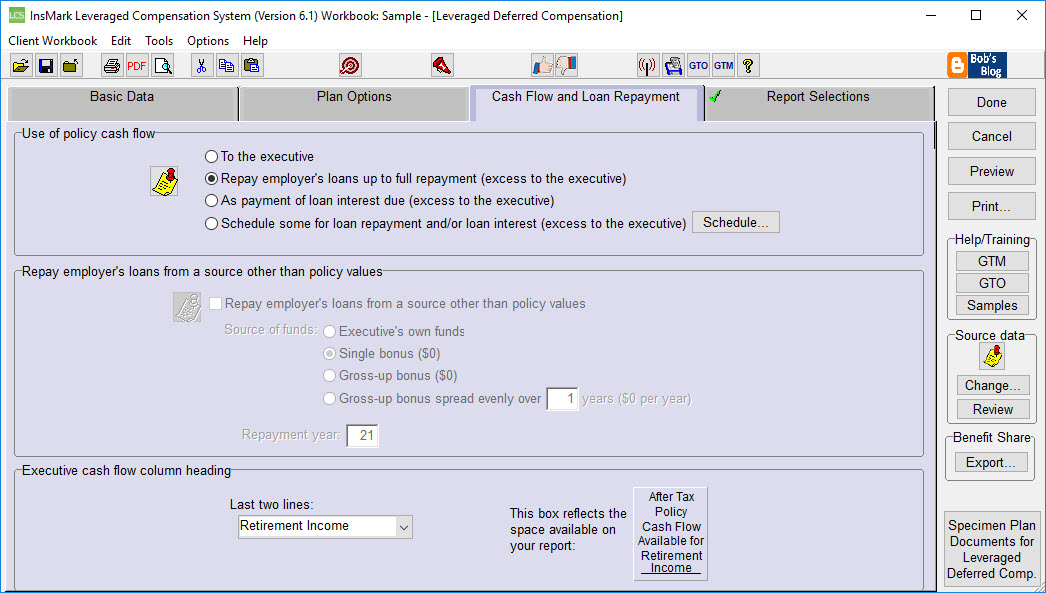
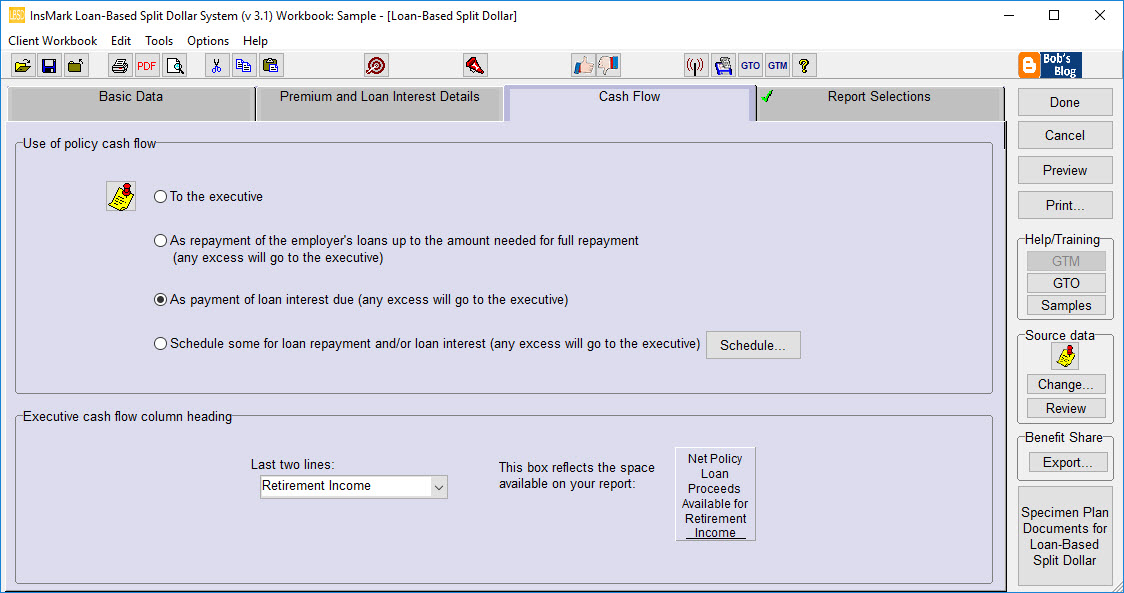
The illustration reflects $335,000 in after tax policy cash flow at the beginning of year 21 and $135,000 a year thereafter (after tax cash flow means withdrawals to basis; loans, thereafter). $200,000 of the $335,000 of policy cash flow in year 21 repays the loans from the employer. This leaves $135,000 of after tax policy cash flow in year 21 - along with the $135,000 of after tax policy cash flow in succeeding years -- directed to tax free retirement income for the executive
Leveraged Deferred Compensation
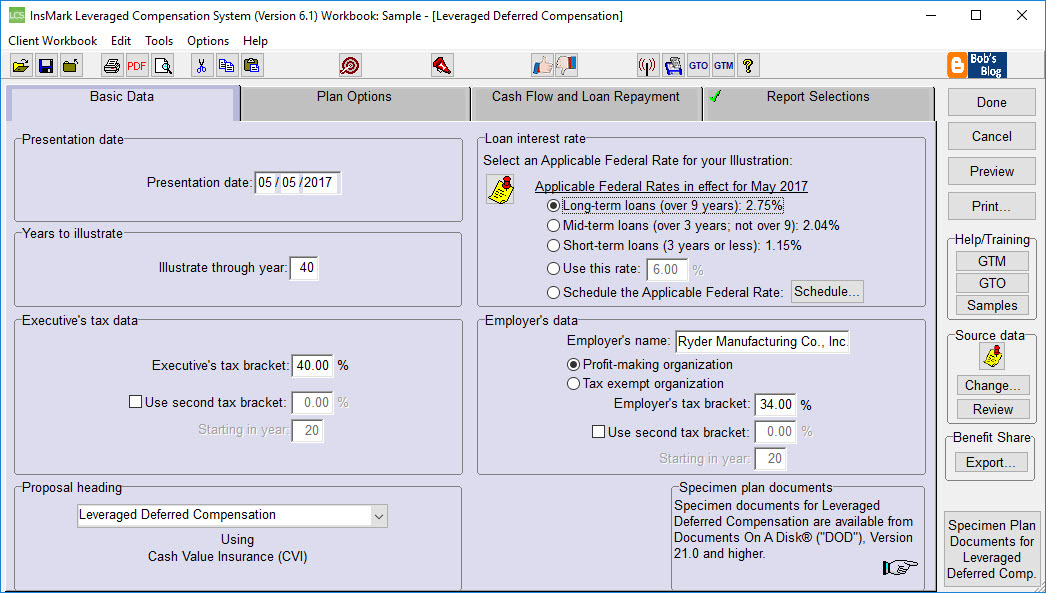
This illustrates Leveraged Deferred Compensation for an executive of a Profit-Making Organization using a $2,500,000 policy with five $100,000 premiums. The insured executive adjusts his compensation downward by $100,000 a year for five years which covers a major portion of the employer's funding costs. The employer uses the after tax dollars provided by the executive's compensation reduction as part of the funding for the loans to the executive who, in turn, uses the loans for premium payments.
Note: The executive’s compensation adjustment that is retained by the employer adds to the taxable profit of the employer and thus increases the amount of income tax due by the employer. In a 34% employer bracket, for example, $100,000 not paid to the executive produces $66,000 in after tax funds for the employer. Adding $34,000 of employer funds to the $66,000 produces the $100,000 loan to the executive. Reducing cash by $34,000 in this case produces a $100,000 loan receivable for the employer -- a credit to earnings of $66,000 ($100,000 - $34,000).
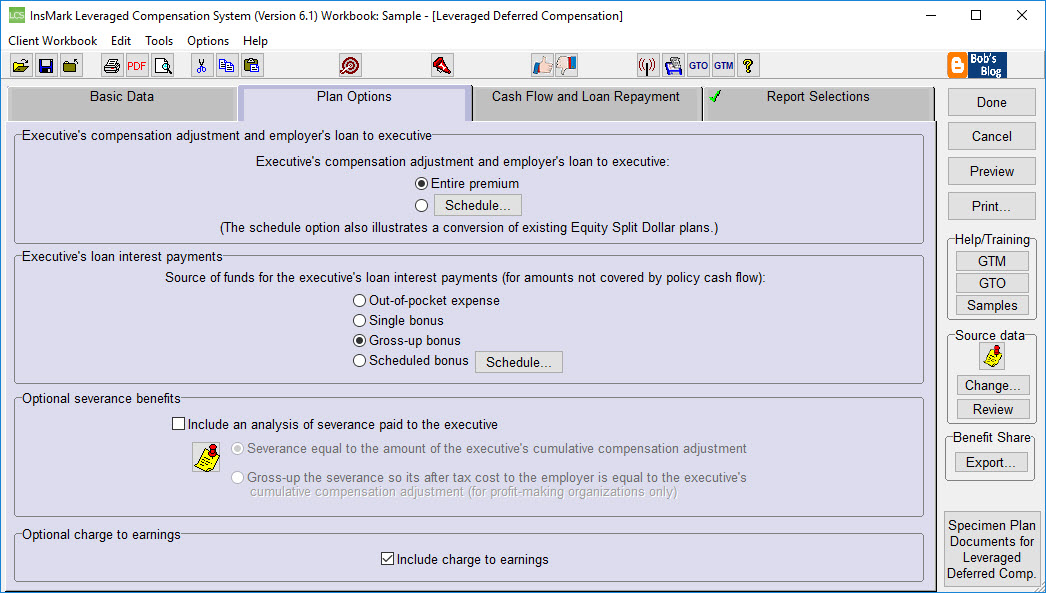
A gross-up bonus (also known as a "double" bonus) is illustrated to provide the executive with the funds for loan interest payments as well as the tax on the bonus. (This reduces the credit to earnings somewhat.)
The illustration reflects $600,000 in after tax policy cash flow at the beginning of year 21 and $100,000 a year thereafter (after tax cash flow means withdrawals to basis; loans, thereafter). $500,000 of the $600,000 of policy cash flow in year 21 repays the loans from the employer. This leaves $100,000 of after tax policy cash flow in year 21 -- along with the $100,000 of after tax policy cash flow in succeeding years -- directed to tax free retirement income for the executive.
This illustrates Leveraged Deferred Compensation for an executive of a Tax Exempt Organization using a $2,500,000 policy with five $100,000 premiums. The insured executive adjusts his compensation downward by $100,000 a year for five years which covers all of the employer's funding costs. The employer uses the dollars provided by the executive's compensation adjustment for loans to the executive who, in turn, uses the loans for premium payments.
Note: In a Tax Exempt Organization’s 0% tax bracket, $100,000 not paid to the executive produces $100,000 in funds for the employer to loan to the executive. The transaction thus produces a $100,000 in annual loan receivables for the employer resulting in a credit to earnings of $500,000 over five years.
A gross-up bonus (also known as a "double" bonus) is illustrated to provide the executive with the funds for loan interest payments as well as the tax on the bonus. (This reduces the credit to earnings somewhat.)
The illustration reflects $600,000 in after tax policy cash flow at the beginning of year 21 and $100,000 a year thereafter (after tax cash flow means withdrawals to basis; loans, thereafter). $500,000 of the $600,000 of policy cash flow in year 21 repays the loans from the employer. This leaves $100,000 of after tax policy cash flow in year 21 -- along with the $100,000 of after tax policy cash flow in succeeding years -- directed to tax free retirement income for the executive.
Note: Sample Leveraged Deferred Compensation Illustrations involving the use of an additional severance benefit are included in the Sample Illustration section of the Leveraged Compensation System.
Leveraged 401(k) Look-Alike
This illustrates Leveraged 401(k) Look-Alike for an executive of a Profit-Making Organization using a $2,500,000 policy with five $100,000 premiums. The insured executive adjusts his compensation downward by $100,000 a year for five years which covers a major portion of the employer's funding costs. The employer uses the after tax dollars provided by the executive's compensation reduction as part of the funding for the loans to the executive who, in turn, uses the loans for premium payments.
Note: The executive’s compensation adjustment that is retained by the employer adds to the taxable profit of the employer and thus increases the amount of income tax due by the employer. In a 34% employer bracket, for example, $100,000 not paid to the executive produces $66,000 in after tax funds for the employer. Adding $34,000 of employer funds to the $66,000 produces the $100,000 loan to the executive. Reducing cash by $34,000 in this case produces a $100,000 loan receivable for the employer -- a credit to earnings of $66,000 ($100,000 - $34,000).
A gross-up bonus (also known as a "double" bonus) is illustrated to provide the executive with the funds for loan interest payments as well as the tax on the bonus. (This reduces the credit to earnings somewhat.)
The illustration reflects $600,000 in after tax policy cash flow at the beginning of year 21 and $100,000 a year thereafter (after tax cash flow means withdrawals to basis; loans, thereafter). $500,000 of the $600,000 of policy cash flow in year 21 repays the loans from the employer. This leaves $100,000 of after tax policy cash flow in year 21 -- along with the $100,000 of after tax policy cash flow in succeeding years -- directed to tax free retirement income for the executive.
This illustrates Leveraged 401(k) Look-Alike for an executive of a Tax Exempt Organization using a $2,500,000 policy with five $100,000 premiums. The insured executive adjusts his compensation downward by $100,000 a year for five years which covers all of the employer's funding costs. The employer uses the dollars provided by the executive's compensation adjustment for loans to the executive who, in turn, uses the loans for premium payments.
Note: In a Tax Exempt Organization’s 0% tax bracket, $100,000 not paid to the executive produces $100,000 in funds for the employer to loan to the executive. The transaction thus produces a $100,000 in annual loan receivables for the employer resulting in a credit to earnings of a $500,000 over five years.
A gross-up bonus (also known as a "double" bonus) is illustrated to provide the executive with the funds for loan interest payments as well as the tax on the bonus. (This reduces the credit to earnings somewhat.)
The illustration reflects $600,000 in after tax policy cash flow at the beginning of year 21 and $100,000 a year thereafter (after tax cash flow means withdrawals to basis; loans, thereafter). $500,000 of the $600,000 of policy cash flow in year 21 repays the loans from the employer. This leaves $100,000 of after tax policy cash flow in year 21 -- along with the $100,000 of after tax policy cash flow in succeeding years -- directed to tax free retirement income for the executive.
Any of the above illustration concepts are superior to classic uses of Deferred Compensation or Salary Continuation arrangements due to the fact that the participating executive has a personally owned policy from which tax free retirement cash flow can be provided through tax free policy loans.
Candidates for these plans are key employees that the business believes deserve a special executive benefit. Any of the plans should also work well for employee shareholders and non-shareholder key employees of C corporations and non-owner employees of all other business entities including tax exempt organizations (the latter being a rich source of prospects for the concept).